
May 28, 2026
How Often Should You Deep Clean Your Home?
My Honest Answer After Years of Cleaning Real Homes
How Often Should You Deep Clean Your Home?
My Honest Answer After Years of Cleaning Real Homes
Most people think their home is clean because it looks clean.
The counters shine. The floors were vacuumed last week. The bathroom smells like lemon. But after years of cleaning busy family homes, luxury properties, apartments, and pet-heavy households, I can tell you — visible cleanliness and true cleanliness are not the same thing.
Regular cleaning manages today's dirt. Deep cleaning removes yesterday's buildup before it becomes tomorrow's damage.
And that difference matters more than most homeowners realize.
Because the homes that get regular deep cleaning don't just look better — they last longer, smell fresher, collect fewer allergens, develop fewer expensive maintenance problems, and honestly just feel lighter to live in.
The good news? You probably don't need to deep clean as often as you fear, especially if you maintain your home properly between visits.
So… How Often Should You Deep Clean?
Here's the realistic schedule I recommend after seeing what actually happens inside real homes.
If you live alone in an apartment, once every 9 to 12 months is usually enough. Lower soil load, less daily wear — it just doesn't build up as fast.
Couples without pets can stretch it a little but not too much. Every 6 to 9 months keeps moderate dust and kitchen buildup from getting ahead of you.
Families with kids are a different story. Crumbs, spills, fingerprints, mystery grime — it adds up fast. I usually recommend every 5 to 6 months.
Pet-heavy homes need the most attention. Hair, dander, oils, outdoor dirt — all of it accumulates quickly. Every 3 to 4 months is realistic.
If anyone in your home has allergies or sensitivities, I'd push that to every 2 months. Air quality matters, and the invisible stuff — dust mites, pet dander, mold spores — is what triggers symptoms.
And if you already have recurring professional cleaning? You can often stretch deep cleans to every 6 to 8 months, because consistent maintenance keeps buildup from getting out of control in the first place.
That's actually why I always say that recurring maintenance and deep cleaning work together, not separately. One makes the other less overwhelming — and less expensive. Crystal Broom Cleaning Services
The Biggest Signs Your Home Is Overdue
Sometimes a home doesn't look dirty — but it feels tired. Heavy. A little off.
These are the signs I notice immediately when I walk into a home that's overdue:
- A faint musty "base layer" smell that doesn't go away after cleaning
- Greasy film on top of cabinets or the fridge
- Baseboards that look white but feel gritty when you run your finger along them
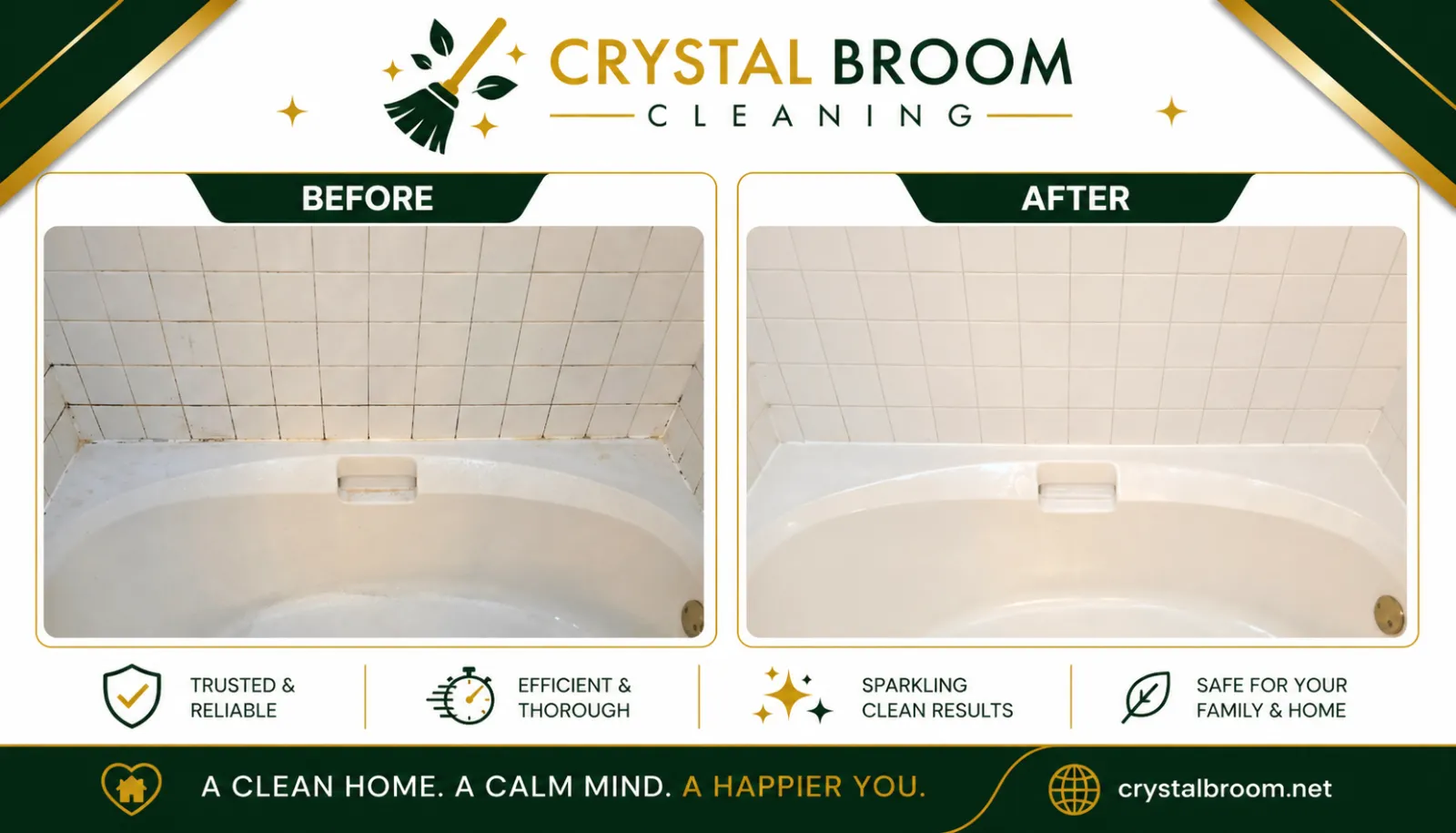
- Dark shower grout that only appears when wet
- Dust webs hiding in ceiling corners
- Sticky light switches and door edges
- Pet-shaped oils pressed into furniture
- HVAC return vents coated in gray dust
- Washing machine seals with hidden mildew building up inside
The invisible buildup is what changes the feeling of a home. Most homeowners focus on eye-level surfaces. Deep cleaning focuses on the places that quietly accumulate years of neglect.
The Areas Homeowners Forget Most Often
In my experience, the most neglected parts of a home are also some of the most important for hygiene, odor prevention, and avoiding damage down the road.
The biggest ones I see skipped over and over: dishwasher filters, washing machine seals and drums, refrigerator drip pans and coils, HVAC return grilles, ceiling fan tops, toilet rim jets, showerhead nozzles, and the interiors of mattresses and pillows.
These spots quietly collect mold spores, grease aerosol, detergent residue, mineral buildup, allergens, and bacteria-feeding biofilm. And because they're out of sight, most people don't notice the problem until there's already an odor — or worse, damage. Before & After Gallery
The $12,000 Mistake I'll Never Forget
One client went about 18 months without moving their refrigerator or cleaning behind it.
What they didn't know: the water line had a slow leak. The drip pan was repeatedly overflowing. The dirty condenser coils had been overheating the compressor.
By the time they noticed the smell — what they described as "wet cardboard" — the damage was already severe. The hardwood floor had cupped. The plywood subfloor had active rot. Mold remediation was required.
The final cost: $8,000 for flooring replacement, $4,000 for subfloor repair and remediation, and $2,000 for a new refrigerator.
What would have prevented all of it? One deep cleaning every 6 months. Pulling out the fridge, checking the line, cleaning the coils, inspecting the drip pan — any of that would have caught the issue when it was still a $5 fix.
That's why I strongly believe deep cleaning is not cosmetic. It's preventative home maintenance.
The Habits That Make the Biggest Difference
Some homes stay cleaner dramatically longer than others. And it usually comes down to a few habits — not perfection.
Shoes off indoors. This is the single most effective thing you can do. Most dirt, road salt, pesticides, and outdoor contaminants come in through shoes. Once inside, that grit becomes airborne dust and damages floors and carpet fibers. A good scraper mat outside, an absorbent mat inside, and dedicated indoor slippers makes a huge difference. Homes with a strict no-shoe rule stay cleaner noticeably longer.
Squeegee the shower after every use. A 30-second habit that can prevent months of soap scum buildup. Soap scum and hard water stains form when water evaporates on surfaces — remove the water first, and the buildup barely forms. Clients who do this consistently often avoid major bathroom deep scrubbing for a year or more.
Always use the range hood while cooking. Cooking grease becomes airborne. Without ventilation, it settles onto cabinets, ceilings, the top of the fridge, HVAC vents — everywhere. That sticky film traps dust and becomes incredibly hard to remove later. Using the fan every time you cook (and cleaning the filter monthly) makes an enormous difference.
Run a HEPA robot vacuum daily. Not because it replaces real vacuuming — it doesn't. But daily removal of surface dust prevents soil from getting ground deep into carpet fibers and grout lines. That alone slows buildup significantly.
Groom your pets weekly. Pet oils and dander are incredibly sticky. A single unbrushed dog can add more soil to a home in a week than a shoe-free adult in a month. Weekly brushing, paw wiping, and washable furniture covers extend the life of your upholstery and reduce allergens substantially.
The Biggest Deep Cleaning Mistakes People Make
Most DIY deep cleans fail for one reason: people clean emotionally instead of systematically.
They see a messy corner and go after it hard, then run out of energy before the important stuff gets done. They use harsh chemicals thinking stronger means cleaner. They scrub stains instead of lifting them. They over-wet carpets. They use the wrong products on the wrong surfaces. They try to clean the entire house in one exhausting marathon — and then don't deep clean again for two years because they dread it.
The worst misconception I hear all the time? That deep cleaning means stronger chemicals. It doesn't. In most homes, friction, good detergent, microfiber cloths, and proper technique matter far more than anything labeled "industrial-strength" or "hospital-grade."
My Most Unpopular Cleaning Opinion
Disinfecting without deep cleaning first is mostly useless. And sometimes it's deceptive.
Most people spray antibacterial products onto surfaces that still have grease, residue, or invisible biofilm. But disinfectants are designed for pre-cleaned surfaces. If dirt remains, the disinfectant gets neutralized, bacteria survive underneath the residue, and you walk away with false confidence.
I've seen this play out firsthand. Real cleanliness starts with physically removing buildup — not with the smell of bleach or a label that says "kills 99.9% of germs."
Mechanical removal of soil is the foundation of hygiene. Full stop.
Deep Cleaning Is About Relief — Not Perfection
If there's one thing I hope you take from this, it's that you don't need to deep clean your entire home tomorrow.
You just need one small action.
Maybe that means cleaning your dishwasher filter tonight. Vacuuming your mattress this weekend. Wiping your washing machine seal. Pulling out the refrigerator. Squeegeeing the shower tomorrow morning.
That one small action creates momentum. And momentum prevents the expensive problems, odors, allergens, and stress I've seen in home after home over the years.
A truly clean home isn't about sparkling countertops. It's about the invisible things you can't always see — but absolutely feel in your breathing, your sleep, and eventually your repair bills.
Deep cleaning isn't punishment. It's taking care of your home — and yourself.
And if you ever need help getting ahead of buildup before it becomes damage, that's exactly what we're here for. Crystal Broom Deep Cleaning Services